
 April 6, 2026 - PAI3 Network, the decentralized personal AI infrastructure platform, today announced the release of its latest platform update, themed “Rock-Solid Experience.” The release delivers a broad set of customer-facing improvements alongside deep security and resilience engineering that fundamentally strengthens the platform’s production readiness.
The update introduces Google and Apple social login alongside existing email and MetaMask wallet authentication, giving users four ways to access their PAI3 node. It makes Agent Chat V2 the default conversational interface, adds cabinet pagination for nodes with large data collections, and replaces loading skeletons with clear signed-out states across all major dashboard tabs.
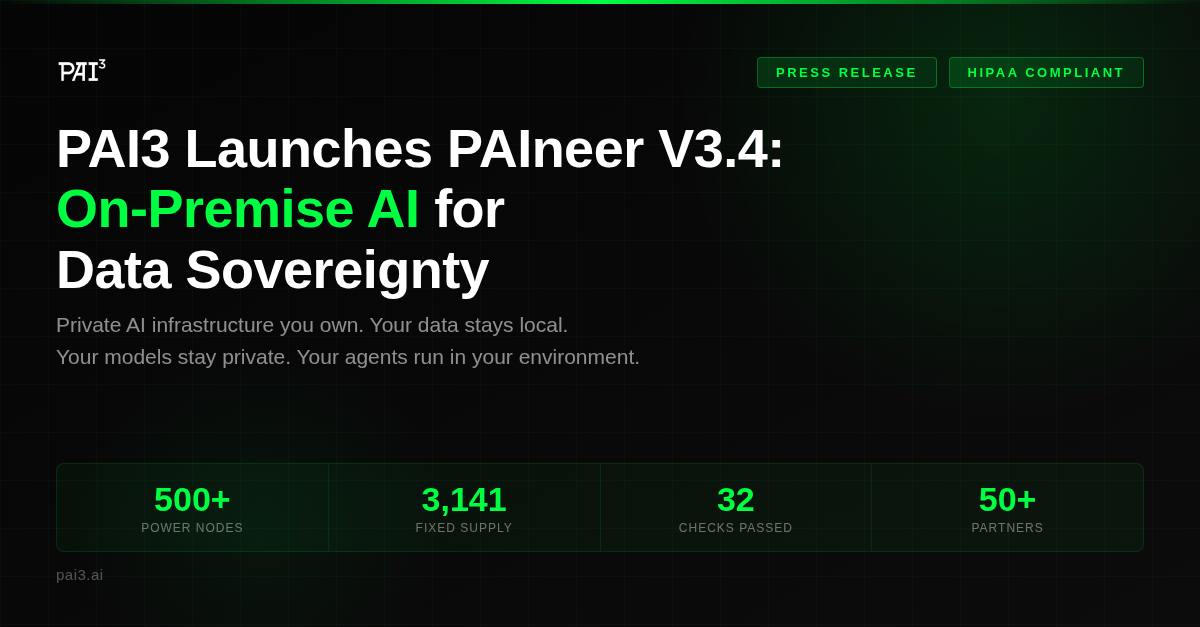
PAI3 has demonstrated strong market adoption, with over 500 Power Nodes deployed from a fixed, architecturally-capped supply of 3,141 nodes. The platform is in active production use across healthcare, legal, and enterprise teams. PAI3 was named a Top 10 AI Project of 2025 by the Binance Incubation Alliance and was a Top 5 Finalist at Consensus 2025 Global, with 50+ ecosystem partners.
“This release is about earning trust. When a doctor or lawyer trusts our platform with sensitive data, ‘it works most of the time’ isn’t acceptable. Every feature, every interaction, every error path has to be solid. We call this release ‘Rock-Solid Experience’ because that’s the bar — not ‘good enough,’ but rock-solid.” — Pradeep Goel, CEO, PAI3 Network
What’s New for Users
The update addresses several experience gaps identified through formal UX testing. Agent Chat V2 is now the default path, offering a more responsive conversational experience. Cabinet pagination ensures that nodes with large document collections load reliably, using intelligent batching with a configurable page size. The Agent Studio, Models, Oracles, and Cabinets tabs now display clear signed-out placeholders instead of infinite loading spinners when a user hasn’t authenticated — a small change that eliminates one of the most common user confusion points.
Social login via Google and Apple joins existing email OTP and MetaMask SIWE (Sign-In with Ethereum) authentication, expanding access to four methods. The login hierarchy is designed for progressive technical sophistication: email for the broadest audience, Google and Apple for convenience, and MetaMask for crypto-native users who want wallet-based authentication.
Why This Matters for Professionals
|
▶ VALUE-BASED CARE: Dr. Affan Ashraf, Angel Kids Pediatrics Dr. Affan Ashraf, MD, CEO of Angel Kids Pediatrics, is building physician-facing AI for value-based care risk management on PAI3 — including training his own models on the platform. Social login means his clinical staff can access the node without crypto wallets. Cabinet pagination means his growing patient data collections load reliably. The 32-point verification means the platform handling his patient data meets a standard of engineering rigor that enterprise healthcare demands. |
|
▶ FUNCTIONAL MEDICINE: Private Diagnostic AI A functional medicine doctor building advanced diagnostic AI on PAI3 benefits directly from the security hardening in this release: 80 audit logging calls mean every data access is traced, master key enforcement prevents fallback credentials in production, and useEffect lifecycle fixes eliminate the glitchy behavior that erodes clinician trust. When patient data is involved, “rock-solid” isn’t marketing — it’s a requirement. |
|
▶ BUSINESS AUTOMATION: Enterprise Workflow Reliability Enterprise teams building secure AI systems for workflow orchestration and document processing on PAI3 need infrastructure that doesn’t break under load. Cabinet pagination with configurable batch sizes, AbortController patterns that prevent race conditions, and gateway middleware for request correlation and metrics deliver the production-grade reliability that business-critical automation requires. |
What’s New Under the Hood
The release includes useEffect lifecycle hardening across six React components, eliminating potential memory leaks and race conditions in asynchronous operations. A new AbortError utility standardizes cancellation handling across the API client, authentication provider, and request deduplication layers. Eighty audit logging calls across the agent, cabinet, and oracle API backends ensure that every significant operation is traced and attributable.
The master encryption key now enforces environment-only configuration in production, rejecting development fallback keys — a critical hardening for nodes handling sensitive data. Gateway middleware for request correlation and metrics provides the observability foundation for production operations. A healthcare feature flag gates all healthcare-specific functionality, ensuring the generic V3.4 release contains no unfinished medical features.
Verified Before Ship
PAI3 subjected V3.4.0.3 to a 32-point verification checklist covering merge integrity, customer experience, quality hardening, backend security, and release engineering. Every check passed. The verification report is available to partners upon request.
Availability
PAI3 V3.4 with the “Rock-Solid Experience” update is available now for all Power Node operators. The release branch is tagged and pushed to the PAI3 code repository.
About PAI3 Network
PAI3 Network is a decentralized personal AI infrastructure platform that enables professionals and enterprises to deploy AI agents, manage encrypted data cabinets, and connect to external systems — all on hardware they own. PAI3’s NFT-anchored ownership model ensures that users maintain full sovereignty over their data, credentials, and AI workflows. The platform is HIPAA-compliant by architecture, with over 500 Power Nodes deployed across healthcare, legal, and enterprise teams.
Learn more at https://pai3.ai/
